A DEXA scan — short for Dual-Energy X-ray Absorptiometry, also written as DXA — is the gold standard imaging test for measuring bone density and diagnosing osteoporosis. Quick, painless, and requiring only minimal radiation, it gives your doctor a precise measurement of the mineral content in your bones — and a reliable estimate of your fracture risk before a break ever occurs.
Osteoporosis is often called a “silent disease” because bone loss progresses without pain or obvious symptoms until a fracture happens. A DEXA scan is one of the most important tools for catching it early — when treatment is most effective and fractures can still be prevented.
At Independent Physicians Medical Center (IPMC) in Northeast Philadelphia, we offer advanced DEXA bone density testing using the Hologic Delphi fan-beam densitometer — a high-performance system specifically designed for precise osteoporosis detection — in a comfortable, welcoming outpatient setting.
What Is a DEXA Scan and How Does It Work?
A DEXA scan uses two low-dose X-ray beams at different energy levels to measure the mineral content — primarily calcium — in your bones. By comparing how much of each energy level is absorbed as the beams pass through bone, the scanner calculates bone mineral density (BMD) in grams per square centimeter.
The test focuses primarily on the hip and lumbar spine — the sites where osteoporotic fractures are most serious and most predictive of future fracture risk. In some cases the wrist or forearm is also measured.
The radiation exposure from a DEXA scan is extremely small — less than a single day of natural background radiation and far less than a conventional X-ray. According to RadiologyInfo.org (published by the American College of Radiology), DEXA is simple, quick, noninvasive, and the most widely used and standardized method for diagnosing osteoporosis.
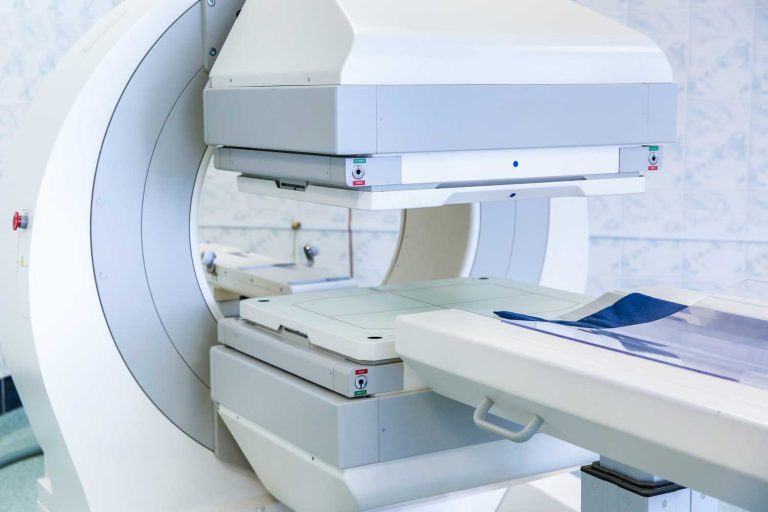
IPMC uses the Hologic Delphi densitometer with fan-beam technology — a high-resolution system that delivers precise BMD measurements with very low radiation and excellent reproducibility for monitoring changes over time.
Who Should Get a DEXA Scan? Screening Guidelines
Osteoporosis affects an estimated 10 million Americans, and another 44 million have low bone density (osteopenia) that puts them at increased fracture risk. Many of them don’t know it. The Bone Health and Osteoporosis Foundation recommends bone density testing for the following groups:
| Group | Screening recommendation |
|---|---|
| Women age 65 and older | ✓ Recommended — routine screening regardless of risk factors |
| Men age 70 and older | ✓ Recommended — routine screening |
| Postmenopausal women under 65 with risk factors | ✓ Recommended — if one or more risk factors present (see below) |
| Men ages 50–69 with risk factors | ✓ Recommended — discuss with your doctor |
| Anyone who has broken a bone after age 50 from minor impact | ✓ Strongly recommended — a fragility fracture is a major warning sign |
| People starting or on long-term steroid therapy | ✓ Recommended — corticosteroids accelerate bone loss significantly |
| People with conditions associated with bone loss | ✓ Recommended — rheumatoid arthritis, chronic kidney or liver disease, hyperthyroidism, malabsorption disorders, early menopause |
| Anyone monitoring osteoporosis treatment | ✓ Recommended — typically every 1–2 years to assess treatment response |
Additional risk factors that may prompt earlier or more frequent testing include a family history of osteoporosis or hip fracture, low body weight (under 127 lbs), smoking, excessive alcohol intake, low calcium and vitamin D intake, and prolonged immobility or inactivity.
How to Prepare for Your DEXA Scan
DEXA is one of the simplest imaging tests to prepare for. Our full DEXA scan preparation guide has complete instructions. Key points:
- Calcium supplements: Stop taking calcium supplements for at least 24 hours before the scan. Calcium tablets can interfere with the accuracy of the bone density measurement.
- Recent contrast imaging: If you recently had a CT scan with contrast dye or a nuclear medicine study, inform your doctor — residual contrast material in the body can affect results. You may need to wait several days before your DEXA scan.
- Clothing: Wear comfortable, loose-fitting clothing without metal zippers, snaps, or buttons. You will not need to change into a gown for most DEXA scans, but metal on clothing can interfere with imaging.
- Eating and medications: You can eat normally and take all medications as usual (except calcium supplements as noted above).
- Pregnancy: Inform your doctor and our team if you are or may be pregnant. DEXA is generally avoided during pregnancy.
What Happens During a DEXA Scan at IPMC?
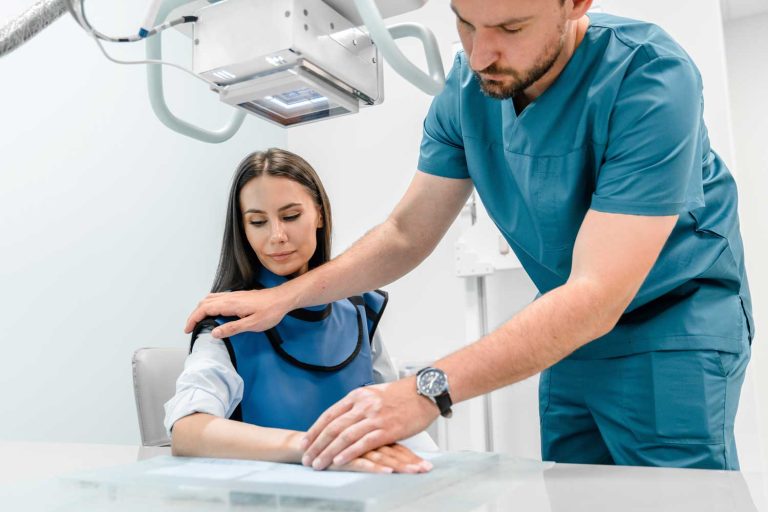
- Positioning. You lie on your back on a flat, cushioned exam table. No enclosed machine, no tube — the DEXA scanner is a low-profile open unit with a scanning arm that passes above you. Most patients find it completely comfortable.
- Hip scan. Your foot is placed in a positioning device to rotate your leg slightly inward. The scanning arm passes slowly over your hip area, capturing bone density measurements at the femoral neck and total hip.
- Spine scan. Your legs are raised and supported on a padded block to flatten your lower back. The scanning arm passes over your lumbar spine (L1–L4 vertebrae), capturing BMD measurements.
- Additional sites (if ordered). In some cases, your wrist or forearm may also be measured — particularly if you cannot be properly positioned for hip or spine imaging, or if additional data is needed.
- Duration. The entire exam takes about 10 to 20 minutes. There are no injections, no contrast dye, and no recovery time. You can eat, drive, and return to all normal activities immediately after.
Understanding Your DEXA Scan Results: T-Score and Z-Score
Your DEXA report includes two scores that describe your bone density relative to reference populations. The most important for clinical decision-making is the T-score.
T-Score: Compared to Healthy Young Adults
The T-score compares your bone density to the average peak bone density of a healthy young adult of the same sex. It is expressed in standard deviations (SD) above or below that average.
| T-score range | Classification | What it means |
|---|---|---|
| −1.0 and above | Normal | Bone density is within the normal range for a healthy young adult. Continue routine screening per your doctor’s guidance. |
| −1.1 to −2.4 | Osteopenia (low bone mass) | Bone density is below normal but not yet at the osteoporosis threshold. Lifestyle changes, supplements, and monitoring are typically recommended. Some patients may be candidates for medication depending on other risk factors. |
| −2.5 and below | Osteoporosis | Bone density meets the WHO diagnostic threshold for osteoporosis. Fracture risk is significantly elevated. Treatment — including prescription medications, calcium, vitamin D, and fall prevention — is typically recommended. |
| −2.5 and below + prior fragility fracture | Severe osteoporosis | Highest fracture risk category. Medication therapy is strongly indicated. Your doctor will discuss the most appropriate treatment options for your situation. |
The diagnosis of osteoporosis is based on the lowest T-score recorded at any measured site. For example, if your spine T-score is −2.7 and your hip T-score is −2.1, your diagnosis is osteoporosis — not “osteoporosis in the spine and osteopenia in the hip.”
Z-Score: Compared to Your Age Group
The Z-score compares your bone density to others of the same age, sex, and body size. A Z-score of −2.0 or below in premenopausal women or younger men indicates bone density that is significantly lower than expected for your age — and warrants evaluation for secondary causes of bone loss (such as hormonal imbalances, medication effects, or malabsorption disorders).
DEXA Scan Results: What Happens Next?
The table below summarizes typical next steps based on your T-score result. Your doctor will factor in additional clinical information — age, prior fracture history, family history, medications, and the FRAX fracture risk tool — when deciding on a plan.
| Result | Typical next steps |
|---|---|
| Normal (T ≥ −1.0) | Continue routine screening. Focus on calcium-rich diet, weight-bearing exercise, and vitamin D. Rescreen in 5–15 years depending on age and risk factors. |
| Osteopenia (−1.1 to −2.4) | Lifestyle changes: weight-bearing exercise, adequate calcium and vitamin D, smoking cessation, limit alcohol. Your doctor may calculate your 10-year fracture risk using the FRAX tool to determine whether medication is appropriate. Follow-up DEXA in 1–3 years. |
| Osteoporosis (T ≤ −2.5) | Prescription medication discussion (bisphosphonates, denosumab, etc.), calcium and vitamin D supplementation, fall prevention strategies, and possible referral to an endocrinologist or rheumatologist. Follow-up DEXA in 1–2 years to assess treatment response. |
| Currently on treatment | Repeat DEXA every 1–2 years to monitor bone density changes and assess treatment effectiveness. A meaningful change in BMD typically requires at least 1–2 years of therapy. |
For a deeper guide to understanding your specific numbers, see our article: Understanding Your Bone Density Scan Results.
How Often Should You Have a DEXA Scan?
How frequently you need a DEXA scan depends on your current bone density, risk factors, and whether you are on treatment. General guidance:
- Normal bone density, low risk: Rescreen every 10–15 years
- Normal bone density, moderate risk: Every 3–5 years
- Osteopenia: Every 1–3 years depending on severity and risk profile
- Osteoporosis on treatment: Every 1–2 years to monitor response
- On high-dose corticosteroids: Possibly every 6 months — discuss with your doctor
Your physician will determine the appropriate interval based on your individual case. If you’ve been told to monitor your bone health and haven’t had a recent scan, call IPMC to schedule — we make it fast and convenient.
DEXA at IPMC
Why Choose IPMC for Your DEXA Scan in Philadelphia?
Convenient Location and Flexible Hours
Fast Appointments & Quick Results
Hologic Delphi Fan-Beam Densitometer
IPMC uses the Hologic Delphi — a high-performance fan-beam densitometer specifically designed for osteoporosis detection. It delivers precise, reproducible BMD measurements at the hip and spine, with excellent image quality and very low radiation exposure.
Experienced, Board-Certified Physicians
Every DEXA scan is interpreted by a board-certified radiologist. Detailed reports — including T-scores, Z-scores, and comparison to prior scans — are sent promptly to your referring physician.
Schedule Your DEXA Scan at IPMC in Philadelphia
Osteoporosis can progress silently—but early detection can help prevent fractures and maintain independence. A DEXA scan provides the information you and your doctor need to make informed decisions about your bone health.
If you’re looking for a DEXA scan in Northeast Philadelphia, IPMC is here to help.
- Call 215-464-3300 to schedule your appointment.
- Visit us at 9908 E. Roosevelt Blvd., Philadelphia, PA 19115
- Monday–Friday, 8AM–8PM
At Independent Physicians Medical Center, your health is our priority—every step of the way.