At Independent Physicians Medical Center (IPMC) in Northeast Philadelphia, we provide advanced MRI imaging performed by experienced technologists and interpreted by board-certified radiologists — all in a private, comfortable outpatient setting designed to make your experience as easy as possible.
What Is a Shoulder MRI?
A shoulder MRI (magnetic resonance imaging) is a painless, noninvasive imaging test that uses a powerful magnetic field and radio waves to create highly detailed pictures of the structures inside your shoulder. Unlike X-rays, which primarily show bones, an MRI excels at revealing soft tissues — including muscles, tendons, ligaments, cartilage, and the joint capsule — making it the preferred test for evaluating most shoulder problems.
Each scan produces dozens or even hundreds of individual images, called slices, which can be viewed from multiple angles. These images give your doctor a comprehensive, three-dimensional understanding of the anatomy of your shoulder and any damage or disease present. Because MRI does not use ionizing radiation, it is considered one of the safest imaging methods available and is suitable for patients of all ages, including pregnant women in many situations.
Why Would Your Doctor Order a Shoulder MRI?
The shoulder is a complex ball-and-socket joint made up of three bones (the humerus, scapula, and clavicle), four rotator cuff tendons, the labrum (a ring of cartilage surrounding the socket), multiple ligaments, bursae (fluid-filled sacs that reduce friction), and numerous muscles. Problems can develop in any of these structures.
Your doctor may recommend a shoulder MRI if you are experiencing:
- Persistent shoulder pain that hasn’t improved with rest, ice, or over-the-counter medications after several weeks
- Pain or weakness following a fall, sports injury, car accident, or other trauma
- Difficulty raising your arm overhead, reaching behind your back, or performing daily activities like dressing or lifting
- A popping, clicking, catching, or grinding sensation in the shoulder during movement
- Shoulder pain that wakes you up at night or prevents you from sleeping on the affected side
- Significant weakness in your arm or shoulder that came on suddenly or has gotten progressively worse
- Swelling, stiffness, or a feeling that the shoulder is “loose” or might slip out of place
- A previous shoulder surgery that isn’t healing as expected, or symptoms that have returned after treatment
A shoulder MRI can help diagnose a wide range of conditions, including rotator cuff tears (partial or complete), labral tears (such as SLAP tears and Bankart lesions), tendon inflammation or tendinosis, bursitis, shoulder impingement syndrome, frozen shoulder (adhesive capsulitis), arthritis and cartilage damage, biceps tendon tears, fractures not clearly visible on X-ray, bone tumors, infections, and nerve compression. In some cases, your doctor may also order an MRI to evaluate how well a previous surgery, injection, or physical therapy program is working.
How to Prepare for Your Shoulder MRI
Preparing for a shoulder MRI at IPMC is straightforward. Here’s what you need to know:
Clothing and metal objects. Wear loose, comfortable clothing without metal snaps, zippers, or buttons. You may be asked to change into a gown. Before entering the MRI room, you’ll need to remove all metal objects, including jewelry, watches, piercings, hairpins, eyeglasses, hearing aids, removable dental work, and any electronic devices. The MRI’s powerful magnet can attract metal objects, so it is essential to leave these items in a secure locker.
Medical history. Before your scan, inform your doctor and our technologist if you have any metal implants in your body, including pacemakers, defibrillators, cochlear implants, surgical clips, pins, screws, plates, artificial joints, or metal fragments (for example, from shrapnel or metalwork). Some implants are MRI-compatible and some are not — your care team will verify safety before proceeding. Also tell your team if you have a history of working with metal or if you’ve ever had metal particles in your eyes.
Claustrophobia. If you feel anxious in enclosed spaces, let us know ahead of time. We can discuss strategies to help you feel comfortable, and in some cases your doctor may prescribe a mild sedative to help you relax during the scan. If you take a sedative, arrange for someone to drive you home afterward.
Eating and medications. For most shoulder MRIs, you can eat, drink, and take your regular medications as usual. If contrast dye will be used, your doctor may give you specific instructions.
Allergies and kidney function. If your scan requires gadolinium contrast dye, tell your doctor about any allergies — especially any previous reactions to contrast agents. Also inform your doctor if you have kidney disease, as gadolinium can rarely cause complications in patients with significantly impaired kidney function.
What Happens During a Shoulder MRI?
Understanding the step-by-step process can help ease any concerns. Here’s what to expect at IPMC:
- Check-in and preparation. When you arrive, our staff will greet you, verify your information, and review a safety questionnaire about metal implants and medical history. You’ll change into a gown if needed and store your belongings in a secure locker.
- Positioning. You’ll lie on your back on a cushioned, sliding table. The technologist will position your shoulder and may place small devices called surface coils around the joint to improve image quality. These coils act like antennas that help capture the clearest possible pictures. Cushions and straps may be used to help you stay comfortable and still.
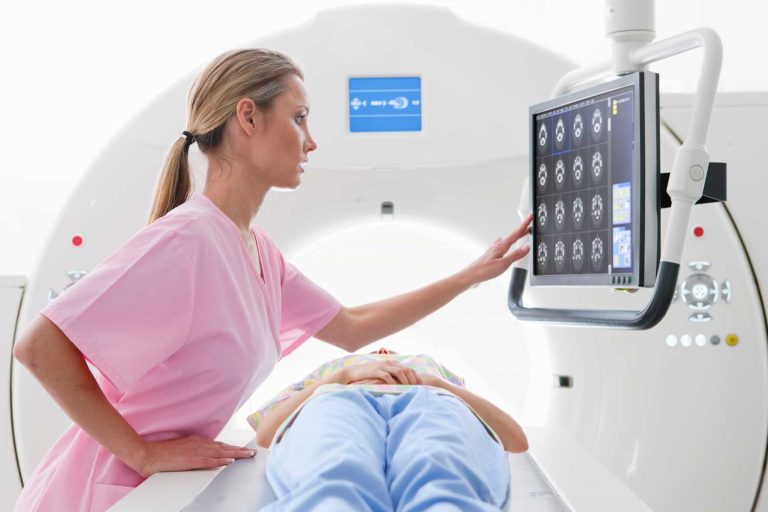
- Entering the scanner. The table will slide gently into the MRI machine — a large, tube-shaped unit. You’ll be positioned so that your shoulder is in the center of the magnetic field. Throughout the scan, you’ll be able to communicate with the technologist through an intercom system, and they’ll be watching you through a window from a nearby room.
- The scan itself. The MRI machine will make a series of loud tapping, knocking, and humming sounds as it captures images. This is completely normal — it’s the sound of the magnetic coils inside the machine working. We’ll provide ear protection (earplugs or headphones) to keep you comfortable. Many patients listen to music during the scan.
- Staying still. It’s important to remain as still as possible during the scan, as even small movements can blur the images. The technologist may ask you to hold your breath briefly for certain sequences. Each image sequence lasts a few minutes, and the technologist will let you know when each one begins and ends.
- Contrast dye (if needed). Some shoulder MRIs require a contrast agent called gadolinium, which is injected through a small IV in your arm. The contrast helps highlight blood vessels and certain tissues, making some conditions easier to see. In certain cases, contrast may be injected directly into the shoulder joint (MR arthrography) to provide an even more detailed view of the labrum and joint capsule. Gadolinium-based contrast is generally very safe, and allergic reactions are rare and usually mild.
- Duration. A typical shoulder MRI takes 45 minutes to one hour. If contrast is used or if additional images are needed, it may take slightly longer.
Is a Shoulder MRI Safe?
MRI is considered one of the safest medical imaging tests available. It does not use ionizing radiation (unlike X-rays or CT scans), and to date, no harmful side effects from the magnetic field or radio waves used in MRI have been documented.
However, there are a few important safety considerations:
Metal implants and devices. The strong magnet used during MRI can interfere with certain implanted devices such as pacemakers, or cause metal implants like screws and pins to shift. Always disclose any metal in your body to your care team. Many modern implants are MRI-compatible, but verification is essential.
Gadolinium contrast. Allergic reactions to gadolinium are rare and typically mild (such as a brief headache, nausea, or skin irritation). In very rare cases, gadolinium can be associated with a condition called nephrogenic systemic fibrosis in patients with severe kidney disease. Your doctor will assess your kidney function before ordering contrast if there is any concern.
Pregnancy. While no harmful effects of MRI on the fetus have been documented, MRI is generally used during pregnancy only when the potential benefit outweighs any theoretical risk. Gadolinium contrast is typically avoided during pregnancy unless absolutely necessary.
Noise. The MRI machine is loud, but ear protection effectively reduces the sound to a comfortable level. Let the technologist know if you need additional support.
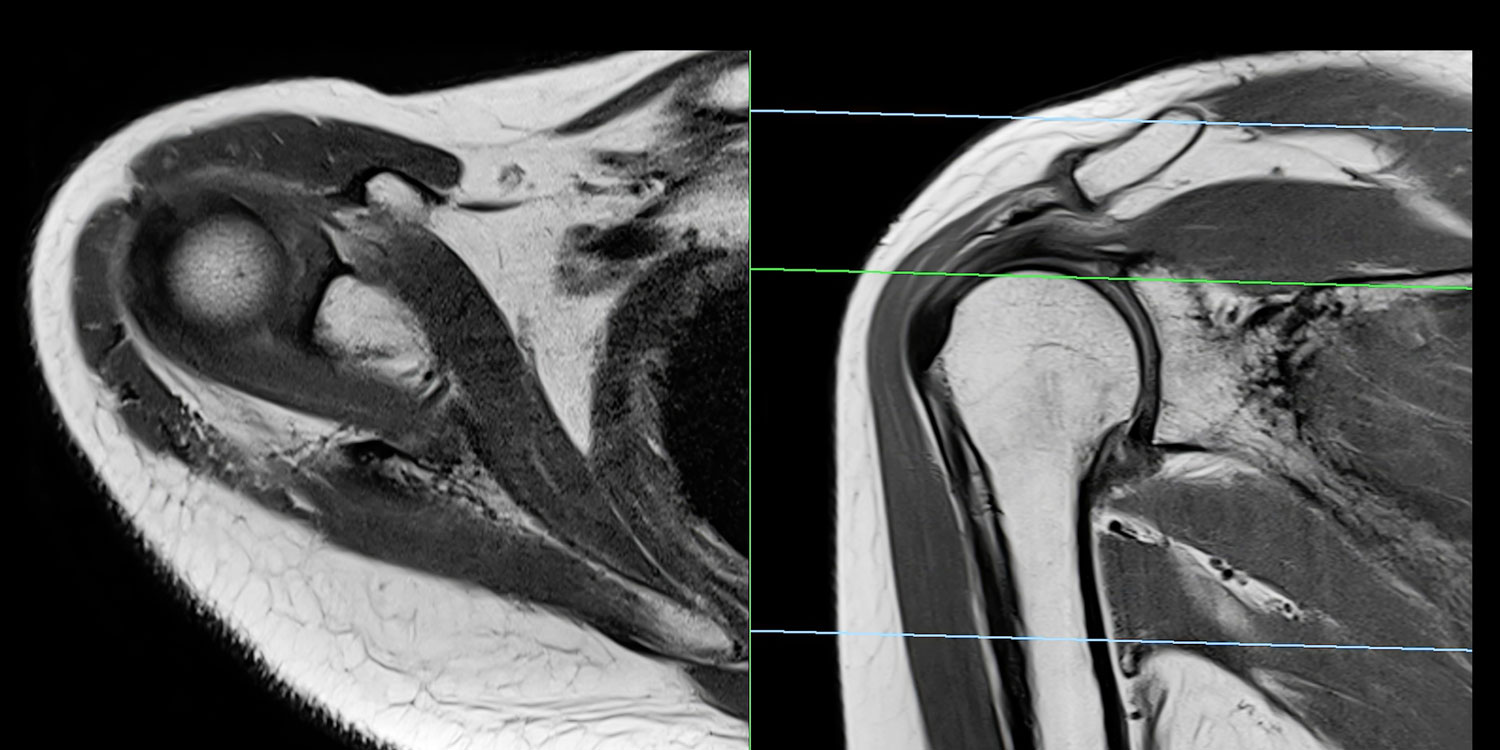
Shoulder MRI scan showing rotator cuff and joint structures
Understanding Your Shoulder MRI Results
After your scan, a board-certified radiologist at IPMC will carefully analyze every image and prepare a detailed report. This report is sent to your referring doctor, who will review the findings with you and explain what they mean for your condition.
Here are some of the key things your radiologist looks for:
Rotator cuff tears. The radiologist can identify partial-thickness tears (where only part of the tendon is torn) and full-thickness tears (where the tendon is completely separated). The size, location, and degree of tendon retraction all influence treatment decisions.
Labral tears. Tears in the labrum — the ring of cartilage that deepens the shoulder socket — can result from traumatic dislocations or repetitive overhead activities. SLAP tears (affecting the top of the labrum) and Bankart lesions (affecting the bottom) are commonly detected on MRI.
Tendinitis and bursitis. Inflammation of the tendons or the fluid-filled bursae in the shoulder appears as areas of increased signal (brightness) on certain MRI sequences.
Arthritis and cartilage damage. MRI can reveal thinning or loss of the cartilage that covers the joint surfaces, as well as bone spurs and other degenerative changes.
Fractures and bone abnormalities. Some fractures that are not visible on X-rays (stress fractures or bone bruises) can be detected with MRI.
Tumors and infections. Although uncommon, MRI can identify masses, infections, or other abnormalities in the bone or soft tissues of the shoulder.
Follow-Up After Your Shoulder MRI
What happens next depends on what the MRI reveals:
Normal results. If no significant abnormalities are found, your doctor may recommend conservative treatment such as rest, physical therapy, or anti-inflammatory medications to manage your symptoms.
Minor findings. Mild tendinitis, bursitis, or small degenerative changes may be treated with physical therapy, activity modification, cortisone injections, or other non-surgical approaches.
Significant findings. If a rotator cuff tear, labral tear, or other structural damage is identified, your doctor will discuss treatment options. Many tears can be managed conservatively, but some — especially larger or complete tears — may benefit from surgical repair. Your MRI results help your surgeon plan the procedure if surgery is needed.
Inconclusive results. In some cases, your doctor may recommend an MR arthrography (MRI with contrast injected into the joint) or additional tests for a more definitive answer.
At IPMC, we work hard to deliver results quickly so you and your doctor can move forward with the right treatment plan without unnecessary delays.