A hand X-ray is one of the most diagnostically informative imaging studies in medicine. In a single painless exam lasting about 10 minutes, it can reveal fractures, dislocations, arthritis, joint damage, bone tumors, foreign bodies, and deformities — providing your doctor with the detailed information needed to guide treatment.
At Independent Physicians Medical Center (IPMC) in Northeast Philadelphia, we provide advanced digital hand X-ray imaging using the Siemens Multix system — delivering sharp, high-resolution images with minimal radiation in a comfortable outpatient setting with no hospital wait times. Learn more about our X-ray services.
What Does a Hand X-Ray Show?
A hand X-ray produces detailed images of all the bones and joints of the hand and wrist, including the phalanges (the 14 finger bones), the metacarpals (the 5 palm bones), and the carpals (the 8 small wrist bones), as well as every joint connecting them. Dense bone appears white; soft tissues and cartilage appear in shades of gray; air and foreign bodies produce their own distinct patterns.
A hand X-ray can identify:
- Fractures — including obvious displaced fractures and subtle non-displaced cracks that may look deceptively minor but require treatment
- Dislocations — joints where the bones have shifted out of normal alignment
- Joint space narrowing — loss of the gap between bones indicates cartilage loss from arthritis
- Bone erosions — small pits or “punched-out” defects at joint margins, characteristic of rheumatoid arthritis and gout
- Bone spurs (osteophytes) — bony projections at joint edges, a hallmark of osteoarthritis
- Subchondral sclerosis and cysts — increased bone density and small cavities beneath the joint surface seen in osteoarthritis
- Soft tissue swelling — diffuse or periarticular swelling visible as increased density in the soft tissues around a joint
- Bone tumors and cysts — enchondromas are among the most common benign bone tumors found in the hand and often appear as lucent lesions within the bone shaft
- Foreign bodies — metal fragments, some types of glass, and other dense materials lodged in the hand are readily visible on X-ray
- Bone density changes — periarticular osteopenia (loss of bone density around a joint) is an early sign of inflammatory arthritis
- Deformities — joint malalignment, subluxation, and deformity from advanced arthritis or old injury
Common Conditions a Hand X-Ray Diagnoses
Fractures and dislocations. Fractures of the hand are among the most common bone injuries, particularly after a fall onto an outstretched hand, a crush injury, a direct blow, or a punch. Fractures of the fifth metacarpal neck (“boxer’s fracture”), finger phalanges, and the scaphoid (a small carpal bone at the base of the thumb) are especially common. A hand X-ray is always the first imaging test ordered for a suspected hand fracture, though some fractures — particularly the scaphoid — may not be visible on initial X-ray and require repeat imaging or MRI if suspicion remains high.
Osteoarthritis (OA). The most common form of arthritis, OA affects the hand in a characteristic distribution — the distal interphalangeal (DIP) joints at the fingertips, the proximal interphalangeal (PIP) joints, and the first carpometacarpal (CMC) joint at the base of the thumb. On X-ray, OA shows joint space narrowing, osteophytes, subchondral sclerosis, and subchondral cysts. Heberden’s nodes (bony enlargements at the DIP joints) and Bouchard’s nodes (at the PIP joints) are the clinical correlate of these X-ray changes.
Rheumatoid arthritis (RA). RA produces a markedly different pattern from OA on hand X-ray. It preferentially affects the metacarpophalangeal (MCP) and proximal interphalangeal (PIP) joints — notably sparing the DIP joints — and causes symmetric involvement of both hands. The earliest X-ray finding is periarticular soft tissue swelling and periarticular osteopenia (bone thinning around the joints). As disease progresses, marginal bone erosions appear at the joint edges, followed by symmetric joint space narrowing and eventually deformity. A hand X-ray is a standard tool for both diagnosing and monitoring RA over time. For more detail, see our guide to how X-rays help diagnose and monitor rheumatoid arthritis.
Gout. Gout causes the deposition of uric acid crystals in joints, producing acute painful swelling. On X-ray, chronic gout produces characteristic “punched-out” erosions with overhanging edges at joint margins — a pattern distinct from both OA and RA. The first MTP (great toe) joint is the classic location, but the hands and wrists are frequently involved. Tophi (collections of urate crystals in soft tissue) may also be visible as dense soft tissue masses on X-ray.
Psoriatic arthritis. This inflammatory arthritis associated with psoriasis can involve the DIP joints — unlike RA — and may produce erosions alongside new bone formation at entheses (where tendons insert into bone). A “pencil-in-cup” deformity, caused by severe erosion of one side of a joint and whittling of the other, is a classic X-ray finding in severe psoriatic arthritis.
Enchondromas and bone cysts. Enchondromas are benign cartilage tumors that most commonly occur in the small bones of the hand. They appear as well-defined lucent (dark) lesions within the bone shaft, often with thin sclerotic margins, and are usually found incidentally or after a pathological fracture through the lesion. Most require monitoring rather than treatment.
Foreign bodies. Metal fragments, certain types of glass, and other dense materials embedded in the hand after trauma are clearly visible on X-ray. Organic materials such as wood or thorns are not visible on X-ray and require ultrasound or MRI for detection.
When Does a Doctor Order a Hand X-Ray?
Your doctor may recommend a hand X-ray if you have:
- Pain, swelling, or tenderness in the hand, fingers, or wrist after a fall, crush injury, punch, or direct impact
- Deformity of a finger or the hand after injury
- Suspected dislocation of a finger or wrist joint
- Chronic joint pain, stiffness, or swelling in the fingers or hand — to evaluate for arthritis and determine its type and severity
- Morning stiffness of the hands and fingers lasting more than an hour, suggesting inflammatory arthritis
- A palpable lump or bony enlargement in the hand
- A finger or hand deformity that has developed over time
- Known rheumatoid arthritis or gout — for baseline imaging and periodic monitoring of disease progression or treatment response
- Suspected foreign body embedded in the hand or finger
Three Standard Views — and Why Each Matters
A standard hand X-ray study consists of three views taken from different angles. Each provides distinct and complementary information.
The PA (posteroanterior) view is the frontal view taken with the hand flat, palm down on the detector. It is the primary view for assessing joint spaces, evaluating arthritis distribution, measuring bone alignment, and identifying most fractures.
The oblique view rotates the hand approximately 45 degrees. It separates the overlapping metacarpal shafts and allows clearer visualization of the metacarpal heads, the PIP joints, and the radial or ulnar aspects of the bones — revealing fractures and erosions that can be hidden in the PA view by overlapping bone.
The lateral view is taken with the hand on its side. It is essential for assessing anterior or posterior displacement of fracture fragments, evaluating joint alignment and dislocations, and viewing the carpal bones in profile.
For suspected scaphoid fractures — a common injury after a fall on an outstretched hand that can be easily missed — additional scaphoid views with the wrist in ulnar deviation are taken to elongate the scaphoid and improve fracture visibility. If scaphoid fracture remains clinically suspected despite normal X-rays, an MRI of the wrist is the most sensitive follow-up study.
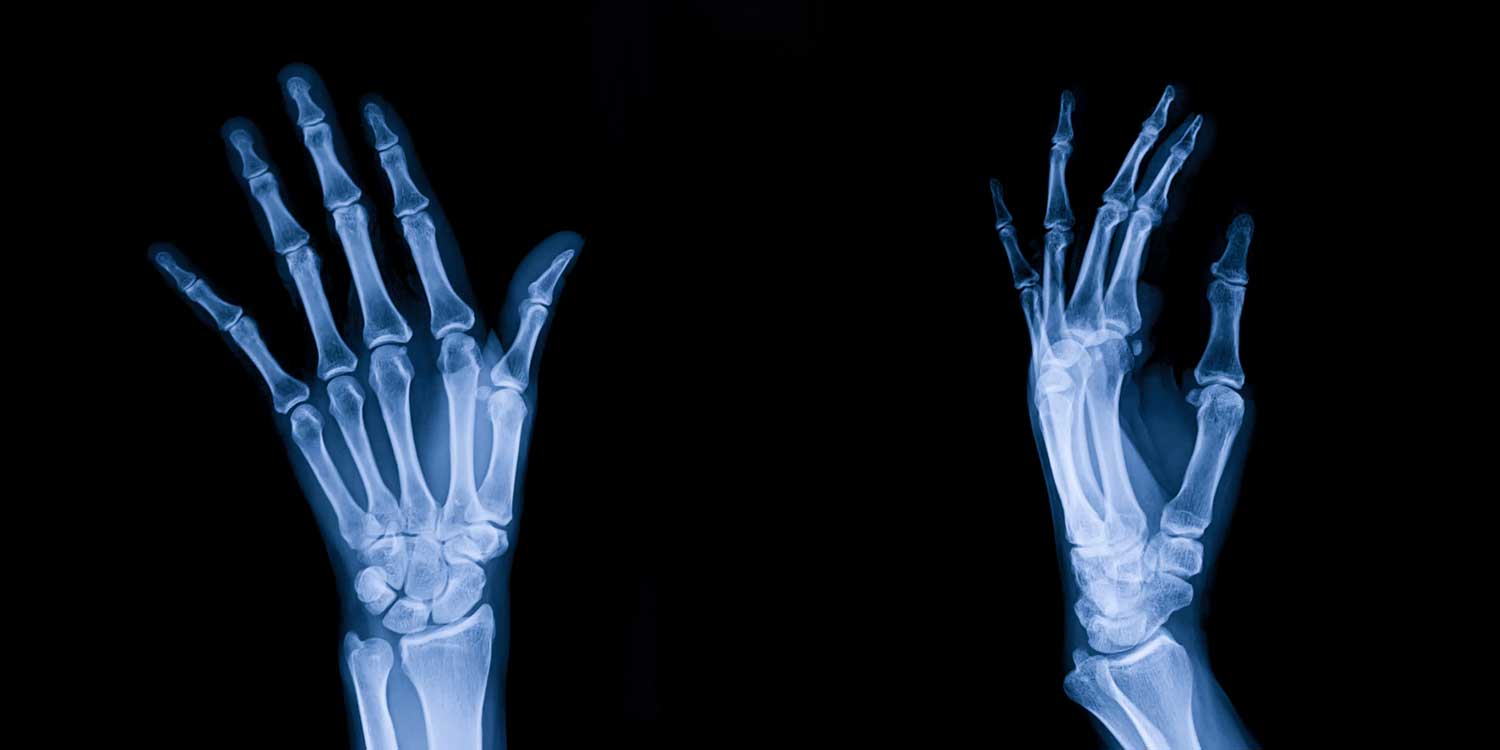
IPMC provides fast digital hand X-ray imaging in Northeast Philadelphia — revealing fractures, arthritis, joint damage, and other conditions in a painless, 10-minute exam with minimal radiation.
How to Prepare and What to Expect
A hand X-ray requires no preparation at all. You can eat, drink, and take your medications as normal. For complete preparation guidelines, see IPMC’s X-ray preparation page.
When you arrive, you will be asked to remove rings, bracelets, and any jewelry from your hand and wrist. Metal jewelry can obscure detail on the image. You do not need to undress — a hand X-ray only images the hand.
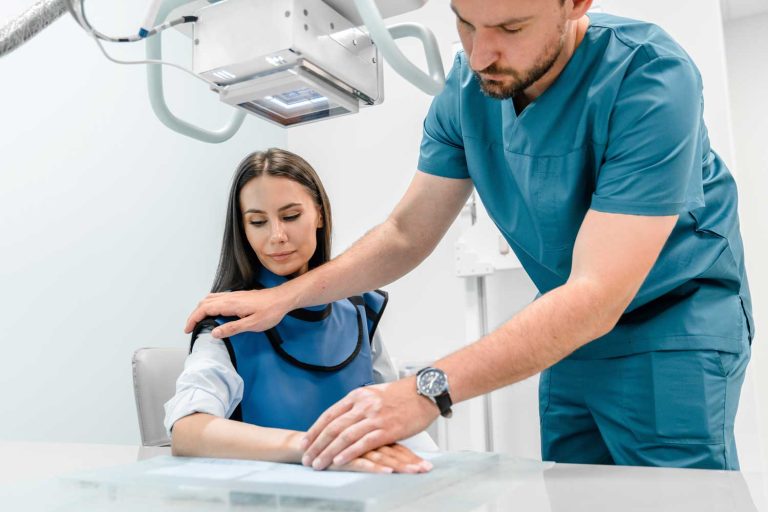
You will place your hand flat on the X-ray detector in different positions as the technologist directs for each view. The technologist may place a small foam wedge under your hand to achieve the correct oblique angle. For each exposure, you hold still for a fraction of a second while the image is captured. The entire exam takes about 10 minutes and is completely painless — you will feel nothing during the exposure itself.
There is no recovery time. You can drive and return to all normal activities immediately after the exam.
After Your Hand X-Ray: Results and Next Steps
A board-certified radiologist at IPMC reviews every image and sends a detailed report to your referring physician, typically within 24 to 48 hours. Your doctor will explain what the findings mean and discuss treatment options.
Depending on what the X-ray shows, your doctor may:
- Confirm a fracture and recommend splinting, casting, or referral to a hand specialist depending on type and displacement
- Diagnose arthritis and recommend treatment, physical therapy, or rheumatology referral based on findings
- Order further imaging — an MRI of the wrist or hand for soft tissue injuries, suspected occult fractures, or early inflammatory changes not yet visible on X-ray; or a CT scan for complex fracture patterns requiring surgical planning
- Monitor a known condition (such as RA or enchondroma) with scheduled follow-up X-rays over time
- Reassure you that there is no fracture or significant bone abnormality